
Irvine, Calif., September 30, 2026 — When a traumatic injury damages the nervous system, understanding what prevents nerve cells from repairing themselves is critical to improving recovery. Yet many laboratory studies examine injuries that leave nearby tissue untouched, missing an integral part of the damage that occurs in real life.
Graduate student Mia Brantley, first author of a new study in eNeuro, helped develop a way to investigate that missing piece. The research comes from the laboratory of Assistant Professor Katherine Thompson-Peer of the UC Irvine Charlie Dunlop School of Biological Sciences.
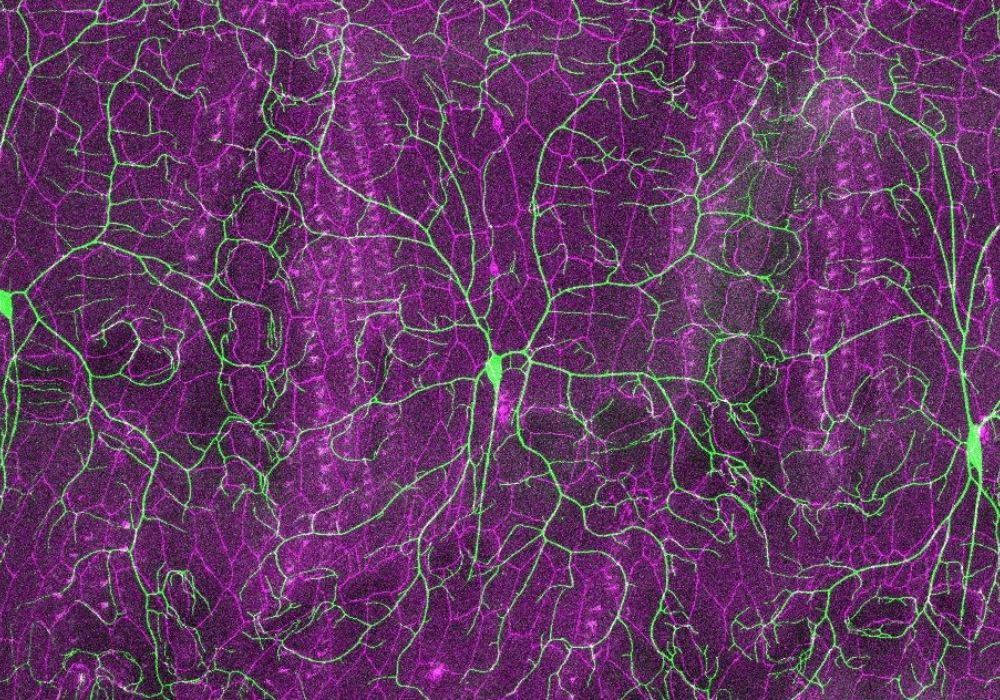
The team studies dendrites, the branches of nerve cells that act like tiny antennas to receive information. Scientists commonly investigate dendrite repair by precisely cutting the branches with a laser. Working with fruit fly larvae, the researchers adapted a “pinch injury” technique that damages both sensory nerve cell branches and neighboring tissue – something laser injury cannot do.
Brantley recalled how the project began.
“The first instance of a successful injury was somewhat serendipitous — I was just trying something out — but the results were very compelling,” she said. “Recreating that injury took weeks, and establishing reproducibility took longer than that.”
Refining the technique became a shared effort.
“Ultimately, the success of this project came from a mix of the unique ingenuity of each lab member and a substantial amount of determination,” Brantley said.
The method allowed researchers to injure half of a cell’s branching network while leaving the other half intact. New branches grew mainly where surrounding tissue remained undamaged. In another experiment, researchers used a pinch on one side of a cell and a laser on the other. New branches spread more successfully into the area where neighboring tissue had been spared.
Closer examination revealed damage to skin cells and the supportive material surrounding cells, called the extracellular matrix, or ECM. That material developed a buildup resembling a scar near the injury. Brantley explained its potential significance.
“Damage to these tissues, especially the ECM, appears to be the major hindrance for proper dendrite regeneration into the empty territory,” she said.
Brantley said the findings point toward a broader approach to studying recovery.
“Characterizing how the dendrites regrow into and interact with the damaged ECM is critical for advancing our understanding of dendrite regeneration, especially when considering how successful recovery from real-world trauma requires healing of both the diseased cell and the neighboring environment,” she said.
Thompson-Peer highlighted the opportunities the new method creates for further research.
“This opens the doors for us to study how the surrounding tissue damage limits regrowth potential, and whether there are ways we can help improve it,” she said.
The research provides a foundation for exploring future repair strategies, even though these further studies must also establish how the findings apply beyond fruit flies and whether improving branch growth can restore function.
Continued support for this work can help researchers move from identifying barriers to testing ways around them, advancing the long-term goal of better recovery after traumatic injury.
About the University of California, Irvine Charlie Dunlop School of Biological Sciences:
Recognized for its pioneering research and academic excellence, the Charlie Dunlop School of Biological Sciences plays a crucial role in the university’s status among the nation’s top 10 public universities, as ranked by U.S. News & World Report. It offers a broad spectrum of degree programs in the biological sciences, fostering innovation and preparing students for leadership in research, education, medicine and industry. Nestled in a globally acclaimed and economically vibrant community, the school contributes to the university’s impact as Orange County’s largest employer and a significant economic contributor. Through its commitment to exploring life’s complexities, the Dunlop School embodies the UC Irvine legacy of innovation and societal impact. For more on the Charlie Dunlop School of Biological Sciences, visit https://www.bio.uci.edu/.