
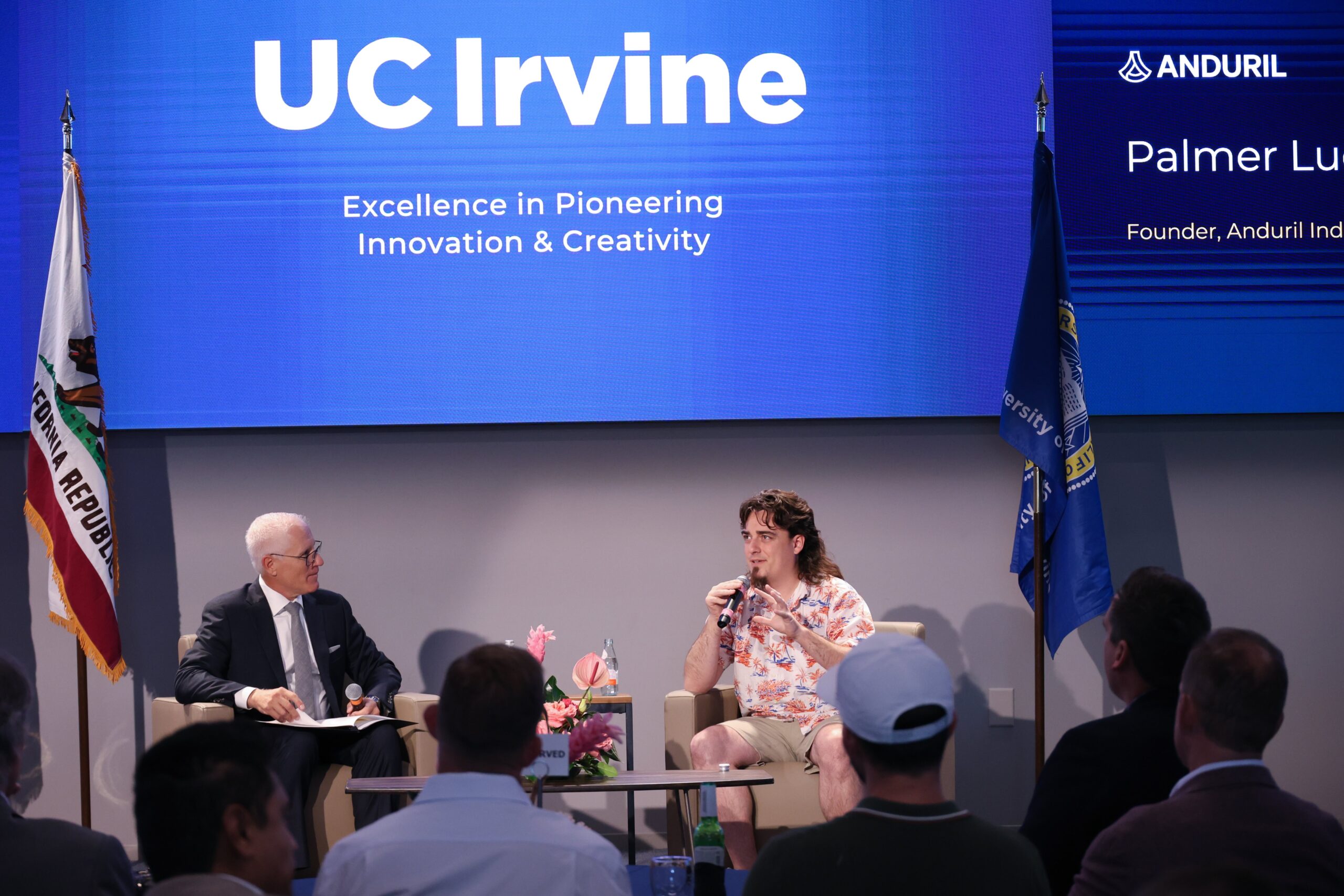
Technology entrepreneur Palmer Luckey visited UC Irvine for an evening devoted to ambitious ideas, unconventional career paths and the role creativity can play in addressing society’s most important challenges.
Luckey, the founder of Oculus and Anduril Industries, joined Frank LaFerla, the Lionel and Fay Ng Dean of the Charlie Dunlop School of Biological Sciences, for a fireside chat Sept. 29 at UCI Beall Applied Innovation. The conversation was part of the inaugural UC Irvine Excellence in Pioneering Innovation & Creativity Forum and concluded with Luckey receiving the first UC Irvine Excellence in Pioneering Innovation & Creativity Award.
Before the public program, members of the school’s Dean’s Leadership Council had an opportunity to speak with Luckey during an exclusive reception. The evening brought together students, faculty members, university leaders and members of the broader business and community network for a wide-ranging discussion about invention, education and the courage required to pursue an untested idea.
LaFerla opened the conversation by connecting innovation with the university’s responsibility to encourage open inquiry and expose students to different perspectives.
“Universities at their core are about fearless curiosity,” LaFerla said. “And that’s what we’re all here for.”
That spirit guided a discussion that traced Luckey’s unconventional journey from a homeschooled student and teenage community college attendee to the creation of Oculus, the virtual reality company he launched while still a young adult. Luckey described years spent building and refining prototypes, often without knowing whether his work would ever become commercially successful.
Rather than pointing to a single breakthrough, he explained that progress came from combining several ideas, repeatedly testing them and recognizing when the experience began to resonate with other people. When friends stopped viewing his demonstrations as an obligation and began showing genuine interest, he started to believe the technology could become something larger.
The story offered an encouraging message for students and aspiring entrepreneurs: transformative ideas do not always emerge through a predictable sequence of degrees, jobs and promotions. They can also grow from curiosity, persistence and the willingness to act when an opportunity appears.
Luckey also spoke candidly about the importance of seeking honest feedback. Friends and family may be supportive, he noted, but entrepreneurs also need informed people who can evaluate an idea objectively and identify its weaknesses. Once an organization begins to grow, he said, leaders must recognize their own limitations and surround themselves with people whose strengths complement their own.
“Find the people who are good at the things that you’re bad at and be hyper aware of that,” Luckey said.
That advice was especially relevant to the undergraduate and graduate students in attendance, including those who may be considering a startup, developing a new treatment or exploring how an early-stage idea could make a difference. Luckey emphasized that leading a company is not simply an opportunity to continue doing one’s favorite work. It requires building a team, solving unexpected problems and remaining focused on the organization’s larger purpose.
The conversation also explored how emerging tools could expand educational opportunities. Luckey described virtual reality as a way for students to practice using costly equipment, explore distant or historical places and encounter information in a more visual and hands-on manner. Such experiences could be especially valuable for students who do not learn most effectively through traditional textbooks or lectures.
“The more flexibility that we can have in how you teach each kid, the better,” Luckey said.
At the same time, Luckey cautioned against treating any single technology as a complete solution. New tools are most effective, he suggested, when they support strong teachers, engaged students and an educational system that is already working toward clear goals.
LaFerla noted that this flexibility holds particular promise for the life sciences, where students are often asked to understand three-dimensional structures and processes through two-dimensional images. New approaches could help make complex subjects more approachable while giving learners additional ways to explore and understand the world around them.
The evening also touched on science fiction, creativity and the importance of examining ideas from many different perspectives. Luckey said stories about imagined futures have often helped inventors consider possibilities that may not yet exist. By looking beyond conventional assumptions, innovators can rediscover overlooked concepts and ask whether advances in knowledge have made once-impossible ideas achievable.
The forum concluded with the presentation of the inaugural award, along with a framed copy of one of Luckey’s early patents. The recognition celebrated not only his accomplishments but also the willingness to question established approaches and pursue ideas capable of creating meaningful change.
For the Charlie Dunlop School of Biological Sciences, the event reflected a broader commitment to connecting students and researchers with influential innovators from beyond traditional academic boundaries. Luckey’s visit offered the UCI community a firsthand look at the persistence behind major accomplishments and a reminder that the next important idea may begin with someone willing to experiment, accept criticism and imagine a future that does not yet exist.