
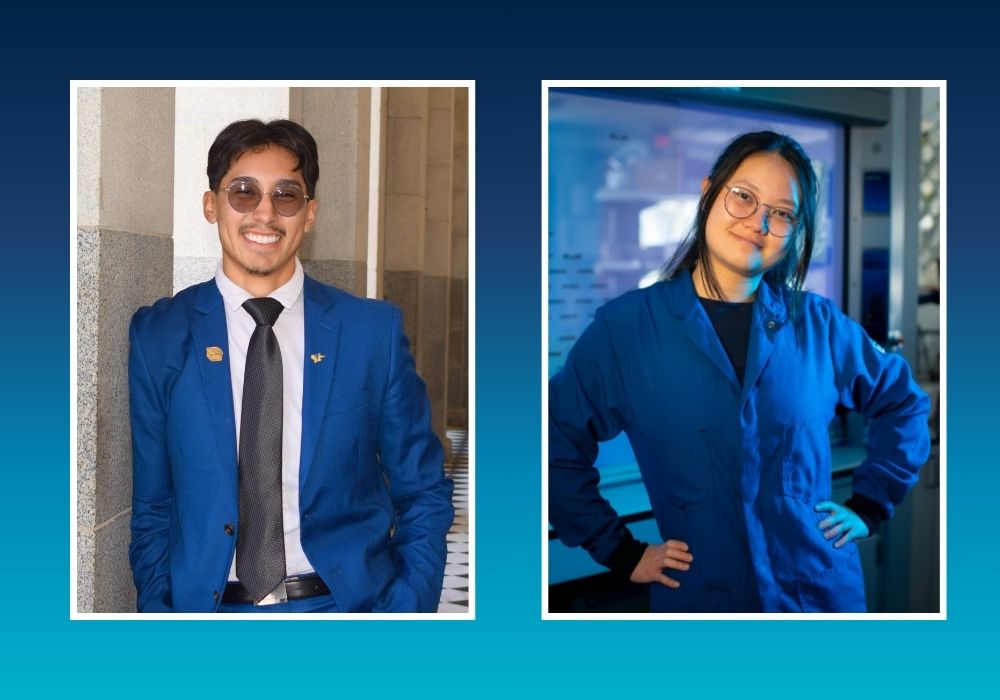
Two undergraduate students from the UC Irvine Charlie Dunlop School of Biological Sciences have been named 2026 Goldwater Scholars, earning one of the nation’s premier honors for students pursuing research careers in the natural sciences, engineering and mathematics.
Steve Salinas and Anny Wang were selected by the Barry Goldwater Scholarship and Excellence in Education Foundation, which awarded 454 scholarships for the 2026-27 academic year from a pool of 1,485 students nominated by 482 institutions. The foundation recognizes sophomores and juniors who demonstrate strong academic performance, research experience and the potential to make significant contributions in their fields.
For Salinas and Wang, the recognition affirms two distinct but equally inspiring paths through the life sciences: one focused on helping the brain recover from injury and disease, the other on understanding how proteins helped shape life on Earth. Together, their achievements reflect the promise of the next generation of scientists emerging from the Dunlop School.
Salinas, a first-generation student and community college transfer, is pursuing a future that brings together research, medicine and service. His goal is to pursue a research-focused M.D. alongside a master’s in leadership or public health, with a focus on advancing therapies for neurological injury and disease.
“My interest in biology began broadly, but it became more focused through my early exposure to healthcare and later through research experiences that connected molecular science to patient outcomes,” Salinas said. “Over time, I found myself especially drawn to neuroscience, particularly the question of how the brain responds to injury and how we might promote recovery.”
At UC Irvine, Salinas has been able to explore that interest through both the classroom and hands-on research. He is involved in clinical neurocritical care research at UCI Health’s Neuro-ICU, where his work focuses on patients with traumatic brain injury and recovery after coma. Salinas describes the research as an effort to better understand how the brain heals after severe injury and how clinicians can improve decisions that may shape patients’ long-term outcomes.
“What excites me most is the translational nature of this work, where research questions are directly informed by real patient cases, and where even small insights can have meaningful clinical implications,” Salinas said.
His path has not been linear. Salinas has moved between fields including chemistry, developmental biology and clinical neuroscience, experiences he said helped him become more adaptable and confident as a researcher. Rather than seeing a nontraditional path as a barrier, he views it as part of what shaped his growth.
“Being named a Goldwater Scholar is both an academic and deeply personal milestone,” Salinas said. “As a first-generation student and community college transfer, my path into research was not always straightforward, and there were many moments where I had to grow into spaces that initially felt unfamiliar. This recognition affirms that persistence and growth matter.”
Salinas credits UC Irvine mentors and experiences with helping him see how scientific discovery can move from the lab and clinic toward real-world impact. Courses such as Clinical Trials in Neuroscience, taught by Professor Joshua Grill, helped him understand how research can translate into patient care, while his work in the Neuro-ICU under Dr. Imad Khan has given him firsthand experience in clinical research settings.
That connection between discovery and service continues to motivate him.
“On a day-to-day basis, I am motivated by the idea that the work I am doing now is building toward something larger than myself,” Salinas said. “Whether it is contributing to research, supporting peers through tutoring, or engaging in community service, I try to stay grounded in the impact that science and medicine can have on people’s lives.”
While Salinas is drawn to the urgent possibilities of medicine and recovery, Wang is inspired by a different but equally profound question: how life itself came to be so complex.
Her path into research began with a fascination for biology at its most fundamental level. Her listed career goal on the Goldwater Foundation website is to pursue a Ph.D. in structural biology and become a tenure-track professor leading a research group that studies the evolution of proteins from the first single-celled organisms to modern humans.
For Wang, proteins are compelling because they are both simple in their basic parts and astonishingly complex in what they make possible.
“I always hated going to Chinese school when I was younger,” Wang said. “Since Chinese is a pictographic language, you’d be hard pressed to sound out a word if you’re looking at it for the first time. What’s nice about proteins is that there’s only an alphabet of twenty amino acids, but it powers all life on earth. Less memorization heavy, but with near infinite possibilities!”
At the Dunlop School, Wang conducts research in the Morehouse Lab, where scientists study how certain immune-related proteins appear across many forms of life. Wang’s work focuses on a human immune protein that may be connected to ancient bacterial defenses, offering clues about how life has changed and adapted over time.
“I’m fascinated with how life developed on early earth,” Wang said. “I just think abiogenesis is the coolest thing ever.”
For Wang, the appeal of research lies in connecting the smallest details of biology to some of the biggest questions humans can ask: How did life begin? How did living systems become so complex? How did tiny changes over time help produce the vast diversity of life around us?
“It is the tension between the micro and the macro, the abiotic and the biotic, and the desire to mend the gap between the two that fuels my passion for research,” Wang said.
Wang said her growth as a scientist has been shaped by a large community of mentors and supporters at UC Irvine. She expressed particular gratitude for her graduate mentor, Eirene, and her advisor, Assistant Professor Ben Morehouse, as well as the Morehouse Lab, the MARC program, Dr. King and scholarship advisor Nisreen.
Her advice to other students is simple: start.
“The best time to get into research is now,” Wang said. “It’s never too late or too early. And even if you can’t get into a lab that exactly fits your interests, having exposure is still priceless.”
Wang knows from experience that students do not need to have their entire path mapped out from the beginning. When she first arrived at UC Irvine, she expected to focus on developmental and cell biology and cancer research. Today, she is a biochemistry and molecular biology major working in a structural biology lab. What mattered most, she said, was staying open to discovery.
“Your interests may change, but all the fundamental lab techniques you pick up stay the same,” Wang said.
As 2026 Goldwater Scholars, Salinas and Wang join a national community of students recognized for their promise as future research leaders. The Goldwater Scholarship supports students preparing for research careers in the sciences, mathematics and engineering, and candidates are evaluated in part on their academic strength, research experience and career aspirations.
For the Dunlop School, their recognition is also a reminder of what undergraduate research can make possible. In labs, clinics and classrooms across UC Irvine, students like Salinas and Wang are asking ambitious questions, developing as scientists and imagining futures in which discovery improves lives and deepens our understanding of the natural world.
Their paths may point in different directions — one toward therapies for neurological injury and disease, the other toward the origins and evolution of life — but both reflect the same spirit of curiosity, perseverance and purpose.
And both suggest a hopeful future for science.