
Why do some people remain cognitively healthy well into their 90s, even when their brains show many of the changes associated with Alzheimer’s disease?
Two new research awards to UC Irvine scientist Vivek Swarup, Ph.D., will tackle this question by studying one of the most informative, but historically understudied, groups in Alzheimer’s research: people who live into their 90s and beyond.
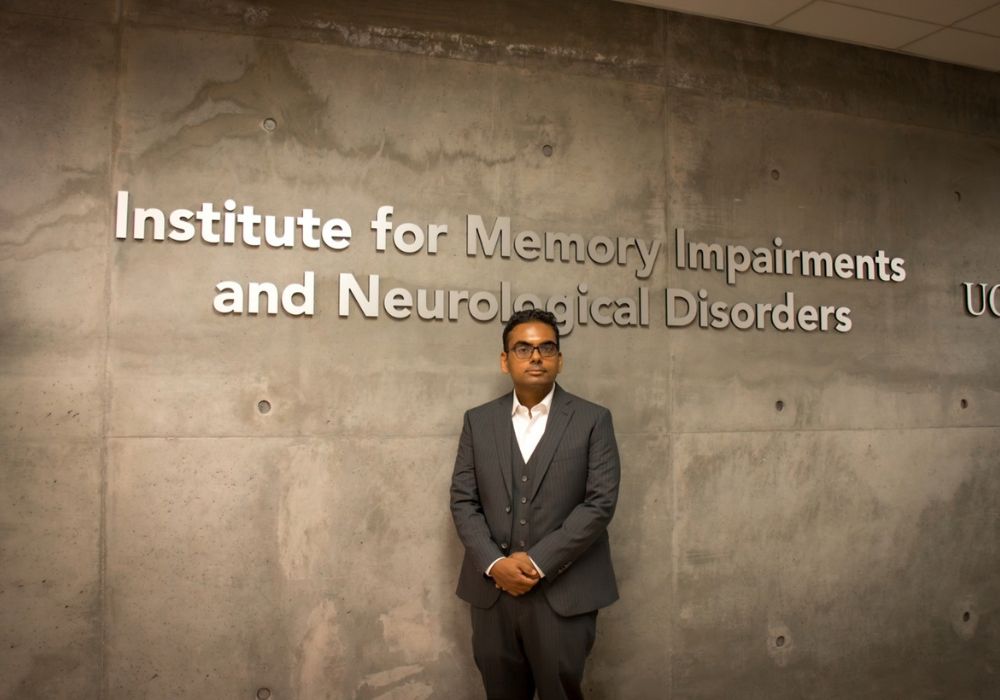
Swarup is a faculty member in the UC Irvine Institute for Memory Impairments and Neurological Disorders (UCI MIND), a Fellow of the UC Irvine Center for the Neurobiology of Learning and Memory (CNLM), and a professor in the Department of Neurobiology & Behavior and Department of Systems Biology at the Charlie Dunlop School of Biological Sciences, as well as the Department of Pathology & Laboratory Medicine at the UC Irvine School of Medicine.
Swarup has received a five-year award from the National Institute on Aging (NIA) and a three-year award from the BrightFocus Foundation’s Alzheimer’s Disease Research program.
Together, the two projects will use advanced genomic technologies to investigate what makes some of the “oldest-old” remarkably resilient to cognitive decline, and why others develop dementia.
The Oldest-Old Offer a Unique Window into Alzheimer’s Disease
Age is the greatest risk factor for Alzheimer’s disease, yet individuals aged 90 and older remain comparatively understudied at the molecular and cellular level. This matters because the oldest-old are not simply an older version of younger people with Alzheimer’s disease. They show striking heterogeneity in both brain pathology and cognitive outcomes.
Some individuals reach very advanced ages with little Alzheimer’s pathology and preserved cognition. Others accumulate substantial amyloid and tau pathology and develop dementia. Still others develop cognitive impairment despite relatively little classical Alzheimer’s pathology. Most intriguingly, some people maintain normal cognition despite substantial Alzheimer’s-related changes in the brain.
These divergent trajectories provide a natural experiment for understanding not only why the brain becomes vulnerable to disease, but also how it can resist pathology or remain resilient to its effects. The projects explicitly compare individuals representing resilience, resistance, vulnerability and susceptibility, allowing the researchers to distinguish molecular programs associated with protection from those associated with cognitive decline.
“Most Alzheimer’s research understandably asks what goes wrong in the brain,” said Swarup. “The oldest-old allow us to ask an equally important question: what goes right? If someone can reach their 90s and maintain cognition despite substantial pathology, their brain may contain biological mechanisms that protect against the consequences of Alzheimer’s disease. We want to identify those mechanisms.”
Building On Decades of Discovery Through The 90+ Study
Both projects build on The 90+ Study at UC Irvine, a major longitudinal research resource devoted to understanding health, cognition, dementia and brain aging in people aged 90 and older. The study was established at UC Irvine in 2003 and grew from the earlier Leisure World Cohort Study, which began in 1981.
The 90+ Study was co-founded by Claudia H. Kawas, M.D., and María M. Corrada, Sc.D., who have spent decades defining the epidemiology, clinical trajectories and neuropathology of extreme aging. Participants have undergone repeated cognitive and neurological assessments, and brain donation has made it possible to relate observations made during life to neuropathological findings after death.
Corrada is a co-investigator on the new NIA-funded project. She is a professor in the Department of Neurology at the UC Irvine School of Medicine, as well as the Department of Epidemiology & Biostatistics at the UC Irvine Joe C. Wen School of Population & Public Health, and a faculty member in UCI MIND. Her role is especially important because the new genomic measurements will be interpreted in the context of the exceptionally rich clinical and pathological information accumulated through The 90+ Study.
The new awards therefore extend, rather than replace, the foundational work of The 90+ Study. Kawas, Corrada and their colleagues established the clinical, epidemiological and neuropathological framework. Swarup’s laboratory will now add high-resolution genomic, epigenomic, spatial and computational layers to investigate the molecular mechanisms underlying those remarkable clinical trajectories.
A Five-Year NIA Project Across 345 Individuals
The NIA-supported project, “Multi-Omic Characterization of Molecular Pathways Driving Vulnerability and Resilience to Alzheimer’s Disease in the Oldest-Old,” will study postmortem brain tissue from 345 participants in The 90+ Study. The researchers will analyze prefrontal and temporal cortex, providing complementary cortical regions in which to examine the molecular biology of resilience and vulnerability.
The project is organized around three interconnected questions. First, which genes and cellular programs distinguish resilient, resistant, vulnerable and susceptible individuals, and where are those cells located in the brain? Second, which DNA regulatory elements and gene regulatory networks control those programs? Third, how do inherited genetic variants influence these molecular states and cognitive outcomes?
To answer these questions, the team will use single-nucleus multi-omics to measure gene activity and chromatin accessibility at cell-type resolution. These approaches can distinguish molecular changes occurring in specific neuronal and glial populations that would be obscured if brain tissue were analyzed in bulk.
The researchers will then use targeted spatial transcriptomics to place important molecular signatures back into their anatomical context. This will make it possible to ask whether protective cell states occupy particular cortical layers, whether resilient brains contain distinctive cellular neighborhoods, and whether interactions among neurons and glial cells differ across cognitive trajectories.
Whole-genome sequencing will provide a third layer of information. By integrating genetic variation with cell-type-specific gene expression and chromatin accessibility, the team will map regulatory effects such as expression quantitative trait loci and chromatin-accessibility quantitative trait loci and search for common or rare variants associated with protective molecular programs.
The goal is to connect inherited variation to gene regulation, cell state, brain organization and ultimately cognitive outcome, creating a mechanistic framework for understanding why some people remain cognitively resilient at extreme ages.
BrightFocus Support Will Build a Spatial Multi-Omic Atlas
The complementary BrightFocus Foundation project, “Beyond Pathology: A Spatially Resolved Multi-Omic Atlas of Cognitive Resilience in Extreme Aging,” is a three-year Alzheimer’s Disease Research Standard Award.
This project will focus on 100 autopsy-confirmed prefrontal cortex samples from The 90+ Study selected across the major cognitive and pathological trajectories. Its emphasis is on preserving spatial context while integrating multiple layers of molecular information.
Traditional single-cell genomic methods can provide extraordinary molecular detail but may lose information about where a cell was located in the tissue. That is important because brain cells operate within highly organized cortical layers and cellular neighborhoods. A protective program may depend not only on what genes are active inside a cell, but also on where that cell is located and which other cells surround it.
The BrightFocus project will integrate spatially resolved transcriptomic information, single-nucleus epigenomic measurements, whole-genome sequencing and targeted spatial proteomic validation. The resulting atlas is intended to connect what a cell is doing, how its genes are regulated, where it is located, and which genetic variants may influence those processes.
The project also aims to develop spatially informed genetic regulatory maps, including expression and chromatin-accessibility QTL analyses, creating a framework for linking genotype to molecular phenotype within defined cellular and anatomical contexts in the oldest-old brain.
Two Awards, One Broader Scientific Question
Although the two projects differ in scale and emphasis, they address the same fundamental question: what biological mechanisms allow some human brains to remain resilient during extreme aging?
The BrightFocus project provides an intensive spatial multi-omic investigation in an initial 100-person cohort. The NIA project expands the effort to 345 individuals, two cortical regions, whole-genome sequencing and large-scale integration of transcriptomic, epigenomic, spatial and genetic information.
Together, the projects shift part of the focus of Alzheimer’s research from degeneration alone toward the biology of protection. If two people have similar levels of Alzheimer’s pathology but dramatically different cognitive outcomes, the person who remains cognitively healthy may reveal protective pathways that would be difficult to discover by studying disease progression alone.
“Resilience changes the question,” Swarup said. “We are still interested in understanding vulnerability and degeneration, but we also want to understand the biology of protection. These individuals have effectively conducted a decades-long experiment for us. Their brains have experienced extreme aging, and some have experienced substantial Alzheimer’s pathology, yet they have maintained cognitive function.”
Learning From Exceptional Aging to Protect Brain Health
The long-term goal is not simply to explain why certain individuals remain cognitively resilient into their 90s. If researchers can identify genes, regulatory pathways, cellular states or interactions among brain cells that consistently distinguish resilient individuals, those discoveries could provide starting points for understanding how similar protective mechanisms might be strengthened earlier in life.
Likewise, naturally occurring genetic variants associated with resilience may reveal biological pathways that modify the effects of Alzheimer’s pathology. Such pathways could ultimately inform biomarker development, therapeutic target discovery and strategies aimed at preserving cognitive health.
“Ultimately, we want to understand whether the human brain already possesses molecular strategies for remaining healthy in the presence of aging and disease,” Swarup said. “If those protective programs exist, the oldest-old may be one of the best places to find them.”
By connecting the pioneering longitudinal work in The 90+ Study with high-resolution genomics, spatial biology and computational analysis, the two new awards aim to move from observing the remarkable phenomenon of cognitive resilience to understanding its underlying biology.
That knowledge could ultimately help researchers pursue a broader goal: not simply treating the processes that damage the aging brain, but discovering ways to preserve the biological mechanisms that keep it functioning.