
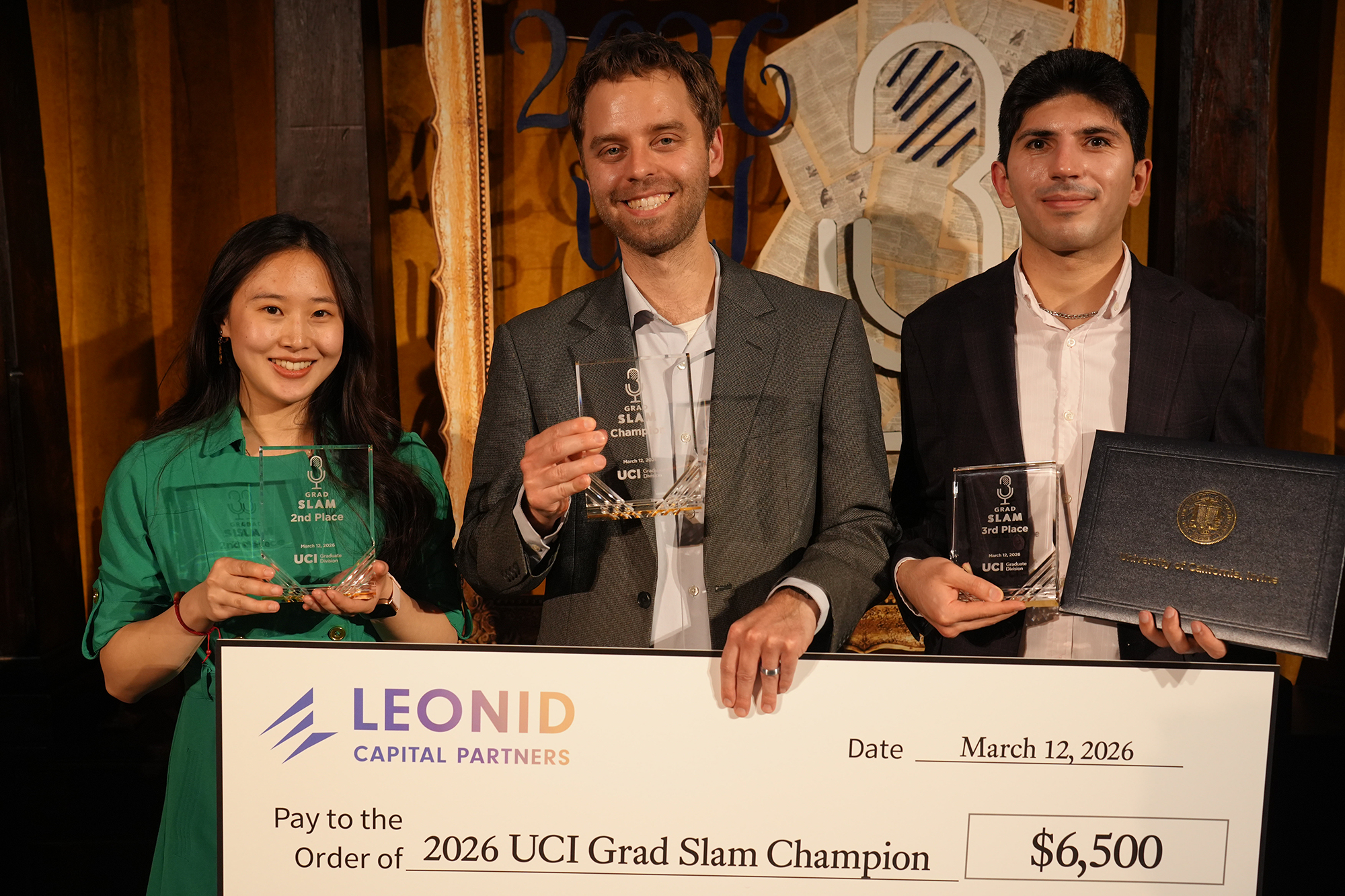
PhD candidate Cameron Geller of the Department of Developmental & Cell Biology has been named the 2026 UC Irvine Grad Slam Champion, earning top honors in a campuswide competition that challenges graduate students to present their research in just three minutes to a general audience. With a clear, compelling message and a strong connection to his audience, Geller rose to the top among a competitive field and will now represent UC Irvine at the UC Systemwide Grad Slam Finals on April 22.
Grad Slam is designed to make research accessible, asking graduate students to step beyond academic language and communicate not only what they study, but why it matters. Participants must distill years of work into a brief presentation that resonates with people from all backgrounds, from fellow researchers to community members with no scientific background. For Geller, that challenge aligned closely with his own purpose as a scientist. He said part of his motivation for competing was to address common misconceptions about cancer research and to help audiences better understand both the progress being made and the challenges that remain. At the same time, he saw Grad Slam as an opportunity to reach people who may not yet see a place for themselves in science. “Part of what I’m trying to do is reach the person in the audience who doesn’t yet see themselves in science,” he said. “If I can stand in front of a general audience and make this work feel real and accessible, maybe that changes something for one person in the room.”
Geller’s path into research was anything but linear. As an undergraduate, a genuine interest in a class led him to connect with a professor who offered him his first opportunity to work in a lab. That experience opened the door to research, but his long-term plans initially pointed elsewhere. After graduating, he explored different career options while preparing for medical school, eventually volunteering in a research lab to strengthen his application. That lab, by chance, focused on cancer biology. Over time, what began as a strategic step evolved into something more meaningful. “Nothing was planned, but none of it was passive either,” he said. “I kept saying yes to what was in front of me, and that openness is what got me here.” During his master’s program, he discovered a deeper connection to research and teaching, ultimately shifting his career goals and setting him on the path to a PhD.
That sense of purpose carried into how he approached Grad Slam. While simplifying complex research is a core part of the competition, Geller explained that the greater challenge lies in earning an audience’s attention and helping them understand why the work still matters. “What’s harder is the next step: convincing people that research still needs to happen,” he said, noting that many assume cancer is already a solved problem or underestimate how the disease continues to evolve. He was intentional about crafting a message that would inform without overwhelming and inspire without creating a sense of hopelessness. The most rewarding part of the experience, he said, came from seeing that message resonate in real time. “When people in the room start to connect, when you can see it on their faces, it’s a different kind of satisfaction than anything that happens in the lab.”
For Geller, the experience of competing — and ultimately winning — also reflects a broader commitment to making science more inclusive and approachable. He emphasized the importance of representation and the impact of showing others what is possible. “I didn’t grow up feeling like someone who was built for this,” he said, recalling early experiences that shaped his confidence. “There are people who have heard those same things and are still hearing them, and I want them to see someone who came through it and ended up here.” His story underscores that pathways into science are not always straightforward, and that persistence, support and openness to opportunity can shape unexpected and meaningful careers.
Winning the UC Irvine Grad Slam carries both professional and personal significance. Professionally, it affirms Geller’s ability to take highly specialized work and communicate it in a way that is engaging and understandable to a wide audience — an increasingly important skill in today’s research landscape. Personally, it represents a milestone shaped by the people who supported him along the way, including family members, mentors and educators who helped guide his journey. That combination of growth, resilience and support is reflected not only in his achievement, but in the way he shares his work with others.
As he prepares for the UC Systemwide Grad Slam Finals, Geller is focused on continuing to refine both his research and his ability to communicate its impact. He expressed excitement about the direction his work is taking, particularly as his research begins to uncover new insights into how cancer adapts and how those pathways might be disrupted. Looking ahead, he hopes to pursue a career in biotech or pharmaceutical research and development, where he can contribute to advancing new therapies while continuing to engage broader audiences in understanding science. He is also energized by the growing role of emerging technologies in research, particularly the ways in which new tools are accelerating discovery and opening new possibilities for improving patient outcomes.
The UC Systemwide Grad Slam Finals will take place on April 22, where Geller will represent UC Irvine among the top graduate student communicators across the University of California system. His achievement reflects not only excellence in research, but also the ability to connect, inspire and bring greater understanding to the work being done in laboratories every day.