
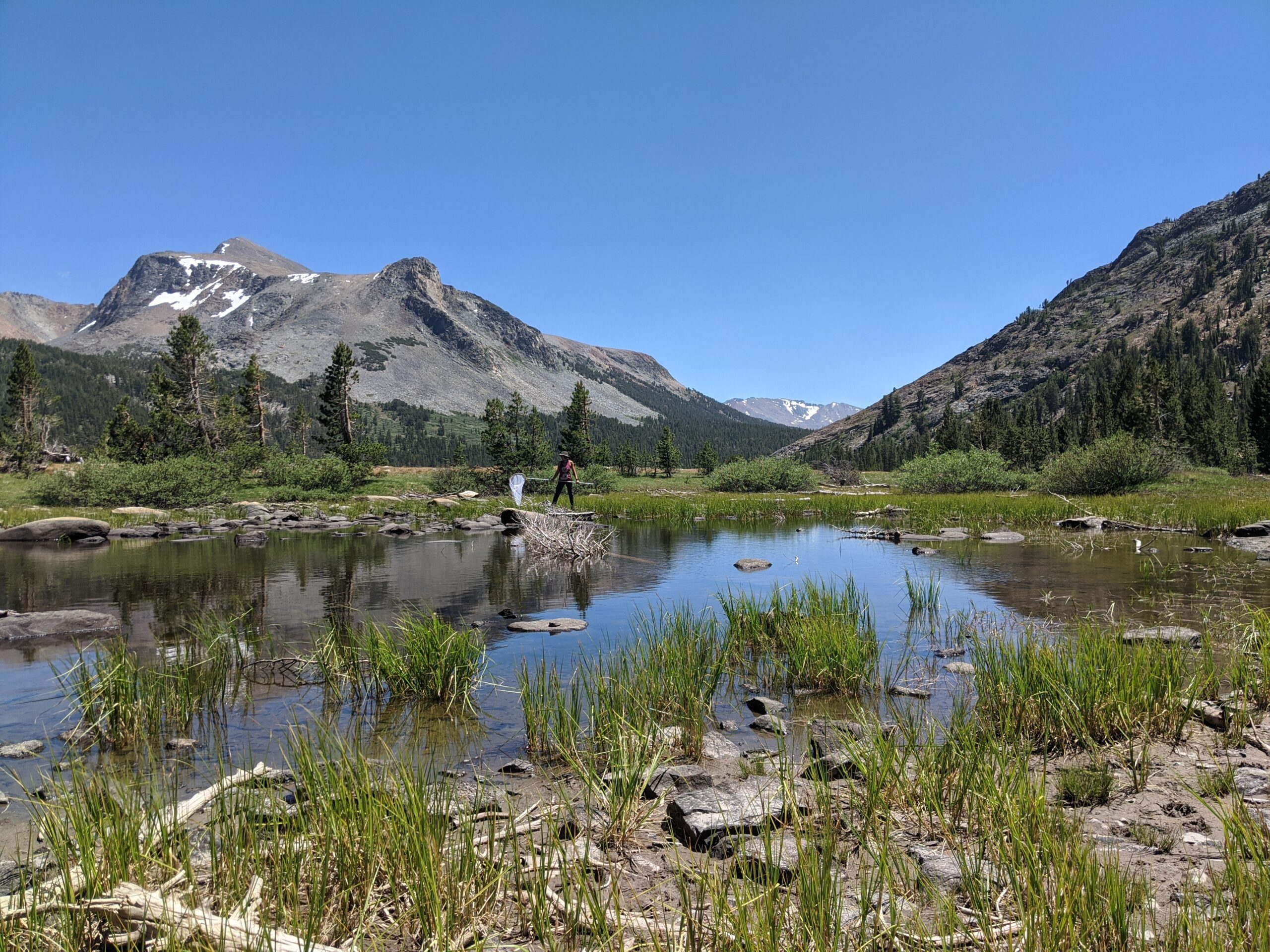
Irvine, Calif., July 14, 2026 — On a summer afternoon in the Sierra Nevada, a mountain pond can look calm and still, reflecting granite peaks and alpine sky. But beneath the surface, these small, shallow waters are anything but stable. In fact, they are among the most thermally variable aquatic ecosystems on Earth, with water temperatures sometimes swinging more than 20°C (68°F) in a single day. According to new research published in the journal Ecosphere, the force driving much of that variability begins months earlier: winter snowfall.
The study found that snowpack largely determines how mountain ponds function during the summer, influencing water temperature, nutrient levels and the abundance of tiny aquatic animals that support the rest of the food web.
The research grew out of a collaboration between two graduate students studying high-elevation ponds: Christine Bonadonna, a former Ph.D. student at the University of California, Irvine, and Mary Jade Farruggia, a former Ph.D. student at the University of California, Davis. Though they began with separate projects, they realized their questions overlapped and combined their efforts to better understand these widespread but often overlooked ecosystems.
Together, they surveyed 30 ponds over four summers, capturing both drought years and one of the highest snowfall years on record. The ponds spanned a broad elevational range, from about 7,500 to more than 11,000 feet, allowing the team to observe how varying snow conditions shaped pond dynamics across the landscape.
Their findings show that snowfall acts as a “master driver” of pond conditions during the summer. In years with heavy snowfall, ponds were larger, colder and more diluted by snowmelt, with lower nutrient concentrations. In drier years, ponds were smaller, warmer and more concentrated. These differences had ripple effects on aquatic life. Warmer, low-snow years tended to support higher numbers of zooplankton, microscopic animals that drift in the water and serve as food for larger animals.
Christine Bonadonna, now an assistant teaching professor at Montana State University, said studying these ponds revealed how closely their behavior is tied to changing snow patterns.
“It was an honor to be one of the first groups to study these ponds, especially in an area that is loved by so many people,” Bonadonna said. “It is especially compelling that snowpack is an important driver for mountain pond dynamics as concerns for snowpack levels continue to increase globally.”
She added that the project required extensive fieldwork in remote alpine landscapes.
“The overwhelming amount of fieldwork and labwork that was required for this project was one of the most significant challenges, but also my favorite part,” Bonadonna said. “It would not have been possible without the incredible team that helped across the years, and it helped to be in such a beautiful place.”
The team also discovered that Sierra Nevada pond water mixes almost every night during summer. As air temperatures drop quickly after sunset at high elevations, the surface water cools and sinks, causing the entire pond to circulate. This daily turnover contributes to the ponds’ dramatic temperature swings and differs from many lower-elevation ponds, where water layers often stay stratified.
The findings are especially timely. Climate projections suggest the Sierra Nevada could lose up to 70% of its snowpack by the end of the century. If that occurs, ponds that persist may become warmer, more thermally variable and more nutrient-rich, reshaping the communities of organisms that depend on them.
Mary Jade Farruggia, now a postdoctoral scholar at the University of Colorado Boulder’s Institute of Arctic and Alpine Research, says the work highlights the importance of paying closer attention to these small but influential ecosystems.
“This work highlights that even though these ecosystems are tiny and are not often formally studied, they are important components of our mountain ecosystems,” Farruggia said. “Ponds are ubiquitous across the landscape, and are processing nutrients, cycling carbon and contributing to biodiversity at levels that cannot be ignored.”
She added that continued research will be essential for understanding how these ecosystems respond to future environmental change.
“It would be exciting to continue investigating the role of ponds in supporting mountain biodiversity and the surrounding terrestrial landscape,” Farruggia said. “In addition, as climate variability increases, understanding how resilient ponds are to change will be an important step toward long-term conservation of these important ecosystems.”
By joining forces across institutions — including UC Irvine’s Charlie Dunlop School of Biological Sciences, UC Davis and the Institute of Arctic and Alpine Research at the University of Colorado Boulder — the researchers produced one of the most comprehensive studies to date on Sierra Nevada mountain ponds. Their work offers new insight into how these small, yet ecologically important ecosystems may respond to a changing climate and underscores the importance of continued research and conservation efforts in high-elevation environments.
About the University of California, Irvine Charlie Dunlop School of Biological Sciences:
Recognized for its pioneering research and academic excellence, the Charlie Dunlop School of Biological Sciences plays a crucial role in the university’s status among the nation’s top 10 public universities, as ranked by U.S. News & World Report. It offers a broad spectrum of degree programs in the biological sciences, fostering innovation and preparing students for leadership in research, education, medicine and industry. Nestled in a globally acclaimed and economically vibrant community, the school contributes to the university’s impact as Orange County’s largest employer and a significant economic contributor. Through its commitment to exploring life’s complexities, the Dunlop School embodies the UC Irvine legacy of innovation and societal impact. For more on the Charlie Dunlop School of Biological Sciences, visit https://www.bio.uci.edu/.